Annual Reports
PT Paramita Bangun Sarana Tbk's annual reports contain management's most considered account of the business. These are the sections, passages and visual pages worth opening in the originals preserved in Sources.
PT Paramita Bangun Sarana Tbk — FY2025 Annual Report — FY2025
The latest and most complete account of the business — record FY2025 results, the palm-oil-refinery demand engine, and the segment economics that sit beneath the headline growth. · Open the full document →
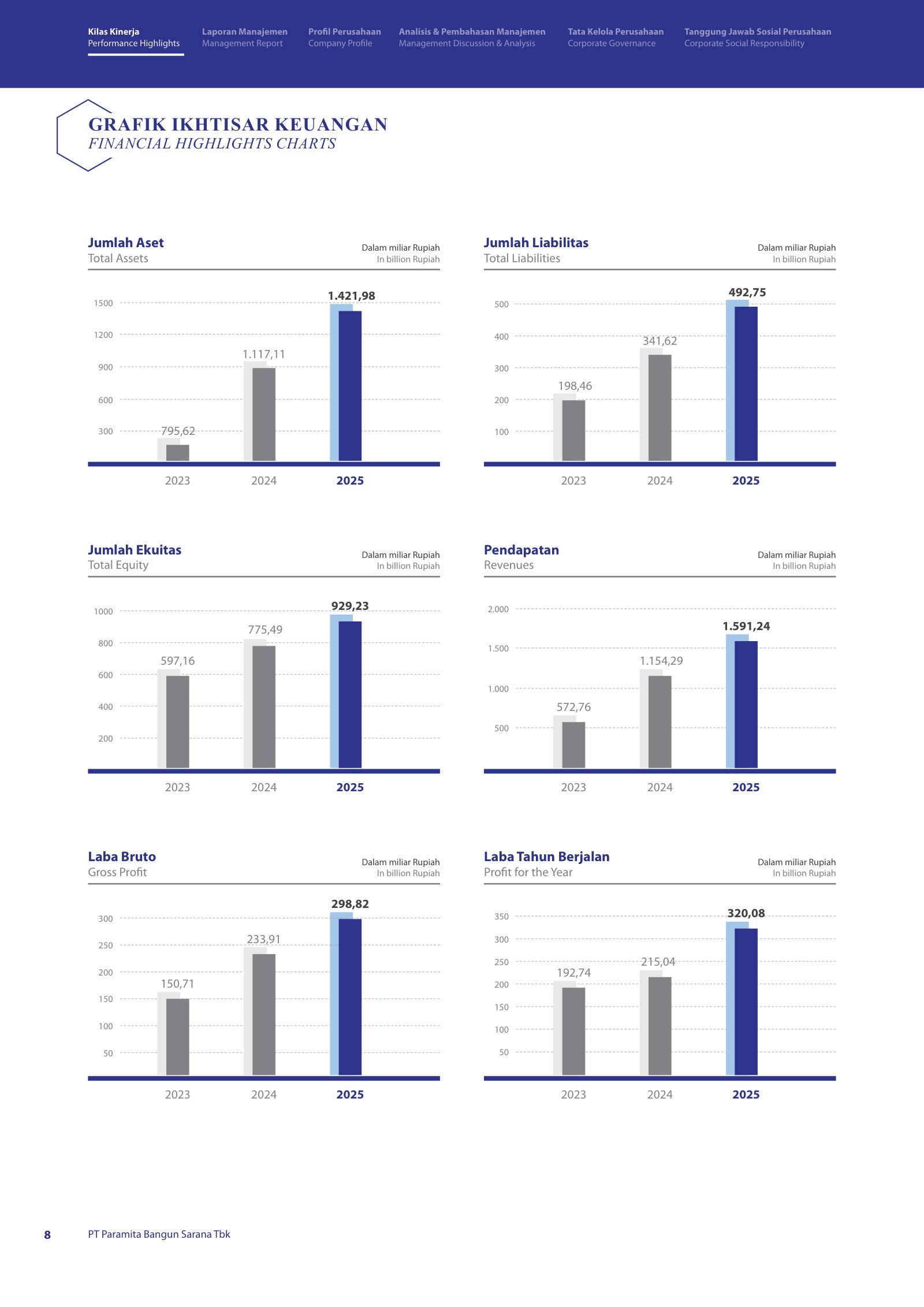
Financial Highlights Charts — p. 7 · Read the full section →
The three-year trajectory at a glance: revenue, profit, assets and equity all rising into 2025.
Board of Directors Report — p. 13 · Read the full section →
Management's own read on 2025 — what drove the year and where it is steering the business into 2026.
The demand engine: palm-oil refinery construction, tied to government downstreaming policy.
One of the subsectors that recorded significant growth was the development of palm oil processing facilities (refineries), driven by rising demand for value-added derivative products and the strengthening of downstreaming policies by the Government. This condition has increased the need for construction services with capabilities to handle highly complex industrial projects, including the integration of civil, mechanical, and electrical works.
p. 13 · Read in context →
FY2025 results in management's words: revenue +37.85% to Rp1,591bn, net profit Rp320bn.
During the 2025 financial year, the Company successfully recorded significant revenue growth of Rp1,591.24 billion, an increase of approximately 37,85% compared to 2024’s Rp1,154.29 billion. […] In line with this performance, the Company recorded profit for the year of Rp320.08 billion, an increase from Rp215.04 billion in 2024.
p. 14 · Read in context →
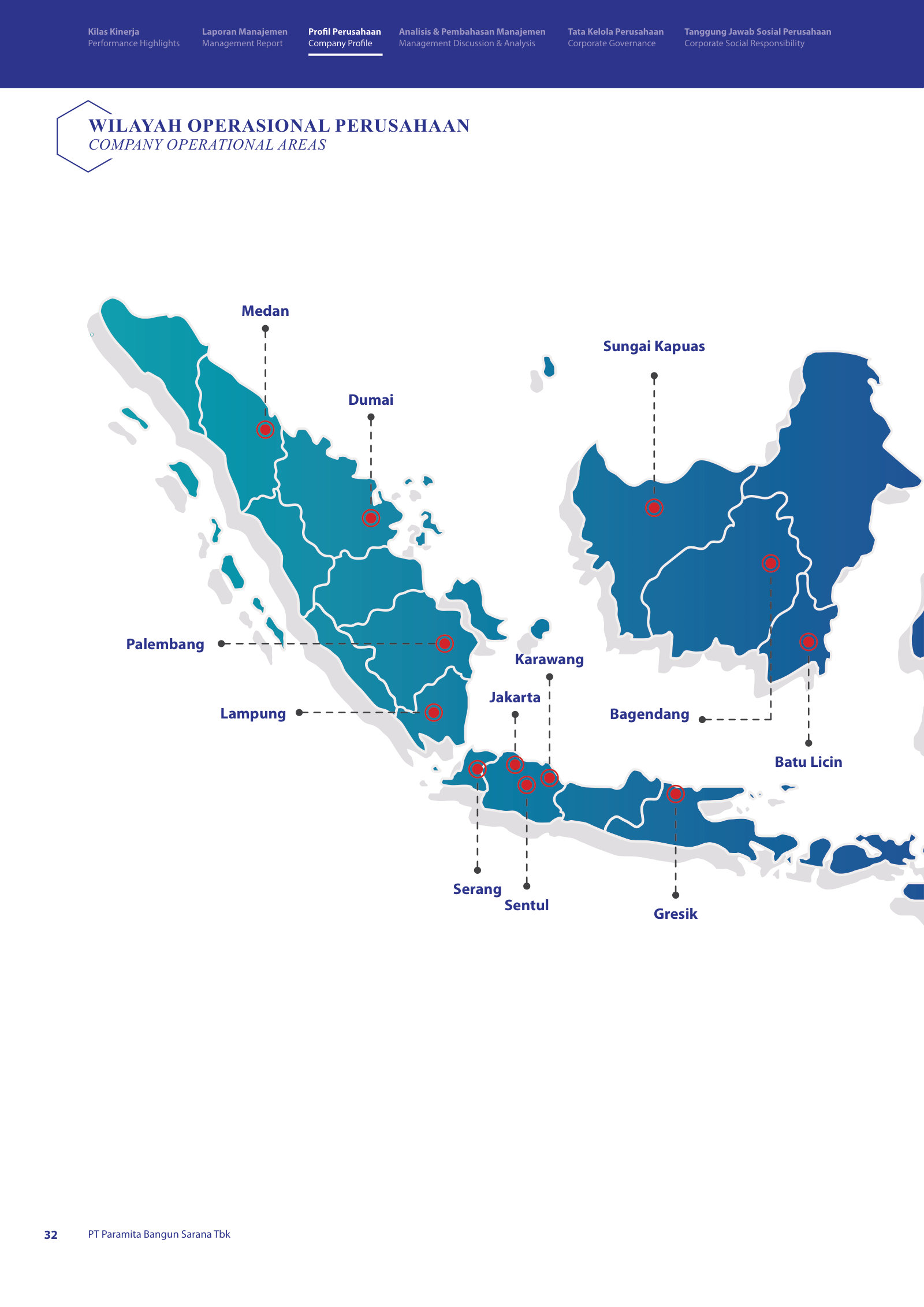
Business Activities — p. 31 · Read the full section →
What the company actually does — civil, mechanical and electrical construction, with a stated concentration in palm oil.
Core competencies and the palm-oil-sector focus that concentrates the order book.
In conducting its business activities, the Company has extensive experience in civil construction, mechanical and electrical works, as well as land clearing activities. Such expertise has been particularly applied to projects related to the palm oil industry sector, which require technical readiness, timeliness, and well-coordinated projec management.
p. 32 · Read in context →
Business Segment Overview — p. 57 · Read the full section →
How the revenue is built: one segment carries the business, the others are supporting.
Revenue mix: construction 91.6%, trading 8.4%, building management immaterial.
The construction segment remained the largest contributor, generating Rp1,457.63 billion or approximately 91.6% of total revenue. […] The trading segment contributed Rp133.14 billion or approximately 8.4% of total revenue, serving as a supporting segment primarily related to project material supply. Meanwhile, the building management segment contributed Rp471.88 million, representing a relatively small portion of total revenue, but still forming part of the Company’s service diversification.
p. 57 · Read in context →
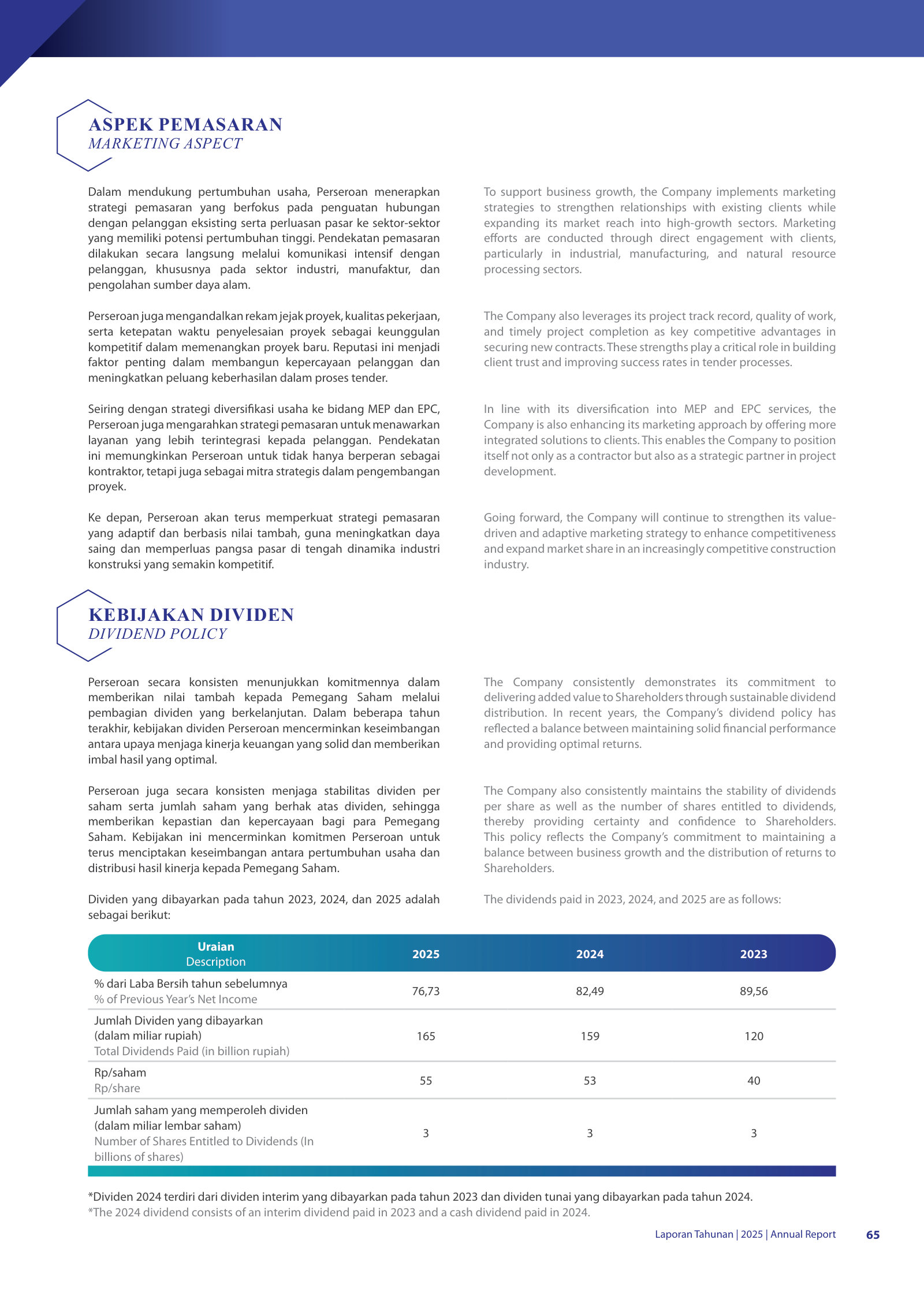
Dividend Policy — p. 66 · Read the full section →
A consistently high payout — a defining feature of the equity story for income-minded holders.
Revenue Recognition (Note 3q) — p. 187 · Read the full section →
The accounting that defines the model — construction revenue booked over time on physical progress.
Percentage-of-completion (output method), with full and immediate provisioning for expected contract losses.
Revenues related to construction contracts are accounted for using the percentage of completion method. Under this method, the revenue recognized equals the latest estimate of the total value of the contract multiplied by the actual completion rate determined by reference to the physical state of progress of the works (output method). […] If it is regarded as probable that a contract will generate a loss on completion, a provision for expected losses to completion is recognized as a current provision in the consolidated financial statements. The loss is provided for in full as soon as it can be reliably measured, irrespective of the completion rate.
p. 189 · Read in context →
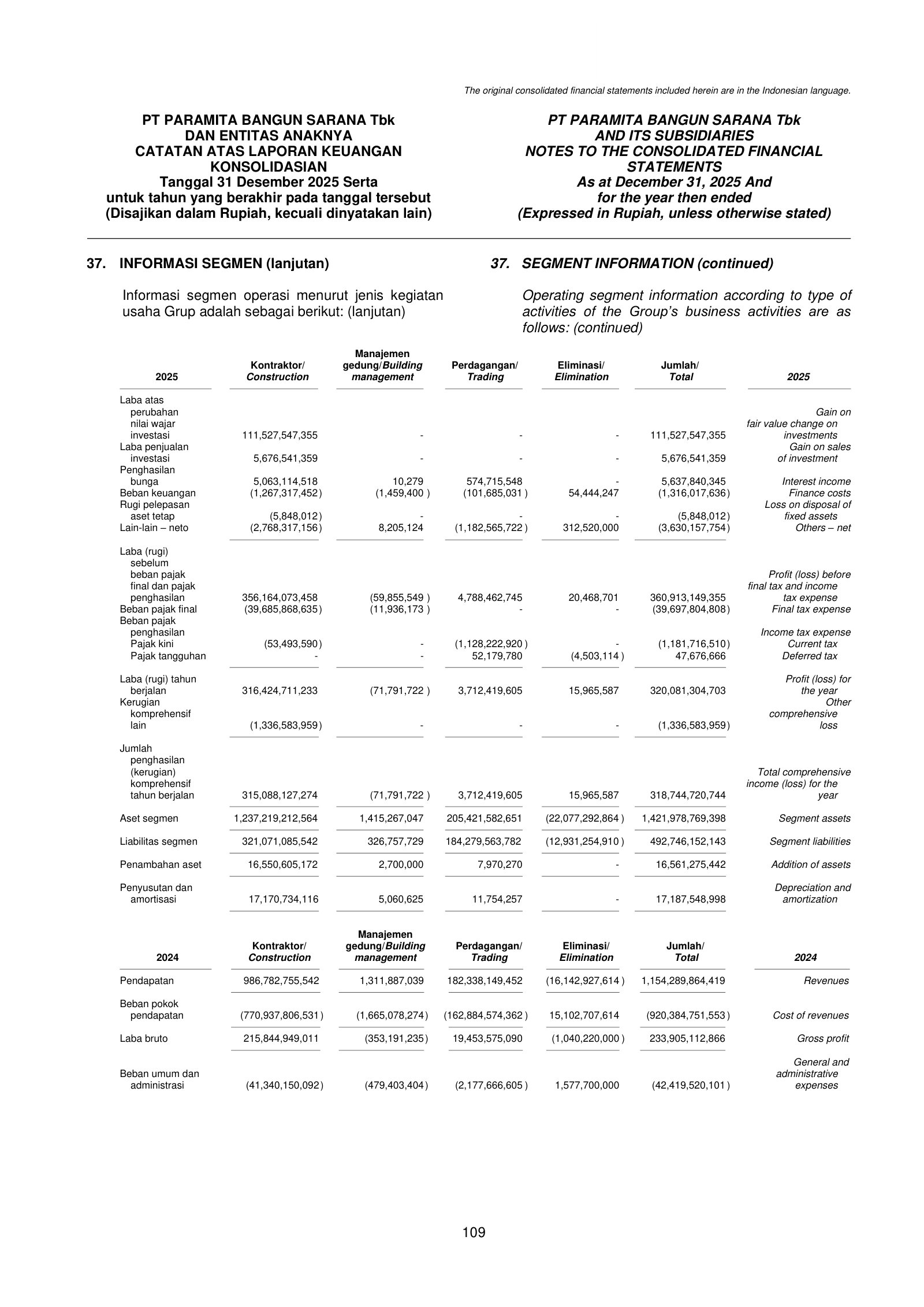
Segment Information (Note 37) — p. 249 · Read the full section →
The audited segment P&L — and where it shows that a large slice of FY2025 profit is investment fair-value gains, not construction.
More annual reports
PT Paramita Bangun Sarana Tbk — FY2024 Annual Report — FY2024 · 303 pages · The prior year and comparison base — revenue Rp1,154bn, before the FY2025 step-up in scale. · Open →
PT Paramita Bangun Sarana Tbk — FY2023 Annual Report — FY2023 · 260 pages · A quieter year (revenue Rp573bn) that frames how sharply the business scaled afterward. · Open →
PT Paramita Bangun Sarana Tbk — FY2022 Annual Report — FY2022 · 268 pages · Earlier baseline for the order book and dividend track record. · Open →
PT Paramita Bangun Sarana Tbk — FY2021 Annual Report — FY2021 · 262 pages · The oldest edition on file — useful for the longer-run view of margins and payout. · Open →